
Kai Cenat’s VIVET SS27 NYFW Debut Draws 180k Livestreamers—and a Gatekeeping Fight
Twitch star Kai Cenat staged VIVET’s first NYFW runway at Cipriani on Sept. 12; Hypebeast and Dazed’s Sept. 14 coverage detail the three-act SS27 collection and the debate over streamer-designers.
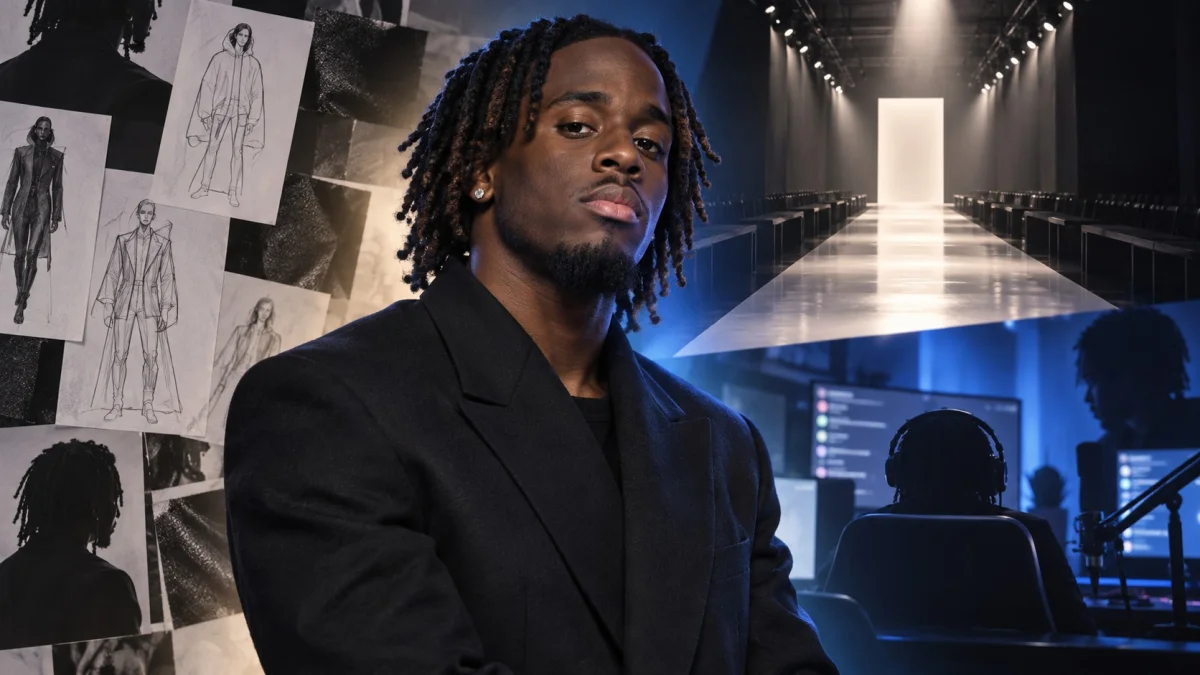
Kai Cenat took the leap from most-streamed Twitch personality to New York Fashion Week designer on September 12, 2026, debuting VIVET’s inaugural Spring/Summer 2027 collection at Cipriani in Lower Manhattan—a show Hypebeast and Dazed dissected in September 14 coverage that treated the clothes and the culture war as inseparable stories.
Hypebeast described a three-act narrative runway: Act One opened on unrefined volume anchored by a hand-sewn Beginner Hoodie; Act Two pushed subcultural leather overcoats, razor-thin denim, and structured boots; Act Three closed on architectural suiting, fluid silk, and fully fastened leather coats. The brand name, from a Latin root meaning “will live forever,” tracks months Cenat spent in Italy studying textile manufacturing, pattern-making, and leather construction. Hero accessories include the Cenova bag and a “Streamer” bag that translates broadcasting hardware into luxury leather, with fabrications spanning cotton canvas, denim, neoprene, and hand-finished leather. Key garments such as a scuba moto shirt, varnished jeans, and cargo work jacket incorporate subtle references to Cenat’s Haitian heritage and carnival tradition through exposed seams, gusseted elbows, and hand-applied patinated waxes, Hypebeast reported. Select pieces went on sale immediately via VIVET’s webstore in a see-now-buy-now drop.
Dazed’s Sophie Wilson reframed the online pile-on. More than 180,000 people livestreamed the show, she reported, yet much of the discourse asked whether a 24-year-old streamer “deserves” a NYFW slot rather than whether a particular jacket worked. Critics mocked Rick Owens homages and unpaid-intern conspiracy theories; fashion commentator Ayọ̀ Òjó argued Cenat “created his own platform, lane and audience” outside traditional pipelines and that degree entitlement is not the same as industry readiness. Wilson’s own verdict was measured: the clothes were “not life-changing,” pulled from Demna and Yeezy playbooks, and lacked a fully distinct vision—typical of early-career collections—while warning that hyperbolic “Virgil Abloh or fraud” binaries give young designers no room to grow. Alton Mason closing in a floor-sweeping fur coat became one of the night’s most circulated images.
That tension is the Influencers-desk news. Fashion weeks have courted creators as front-row amplifiers for years; discomfort spikes when those creators stop selling someone else’s logo and start selling their own. Cenat is not the first famous-person-turned-designer—Dazed cited the Olsen twins, Stella McCartney, and Victoria Beckham as precedent, and nodded to Matilda Djerf’s one-off 2023 NYFW runway as a creator-adjacent exception—but a Twitch-native path still triggers gatekeeping that musician-led labels rarely face at the same volume. Hypebeast’s product-forward writeup and Dazed’s criticism of criticism together document a single mid-September moment: a livestreamed independent debut, a shoppable capsule, and a public argument about who is allowed to call themselves a designer in 2026.
No independent sell-through figures, production budgets, or critic scorecards beyond those outlets’ reporting were attached to the September 14 pieces. The verified package is the show date, venue, three-act structure, Italian study narrative, livestream scale, and the split between product coverage and legitimacy debate—an influencer-economy story that happens to be wearing runway clothes, and one that will be measured next by whether VIVET’s webstore converts curiosity into repeat customers rather than a single viral night.
Related: Steven Bartlett’s Authentic / OBSN creator venture; SheSpeaks study on influencer ad disclosure gaps.
What's Your Reaction?
 Like
0
Like
0
 Dislike
0
Dislike
0
 Love
0
Love
0
 Funny
0
Funny
0
 Wow
0
Wow
0
 Sad
0
Sad
0
 Angry
0
Angry
0

"iShook Opinion" by Beni E Rachmanov, CEO & Founder of iShook. Explore captivating perspectives on entertainment, lifestyle, and sports at ishookdaily.com. Your go-to for engaging insights.















Comments (0)