
Voyager 1 Becomes First Spacecraft to Reach One Light-Day From Earth as NASA Works Data Glitch
NASA's Voyager 1 reached one light-day from Earth, about 16.1 billion miles away, at 5:16 a.m. EST on Nov. 18, 2026, as engineers worked to diagnose why the 1977 probe stopped sending science and engineering data on Nov. 14.
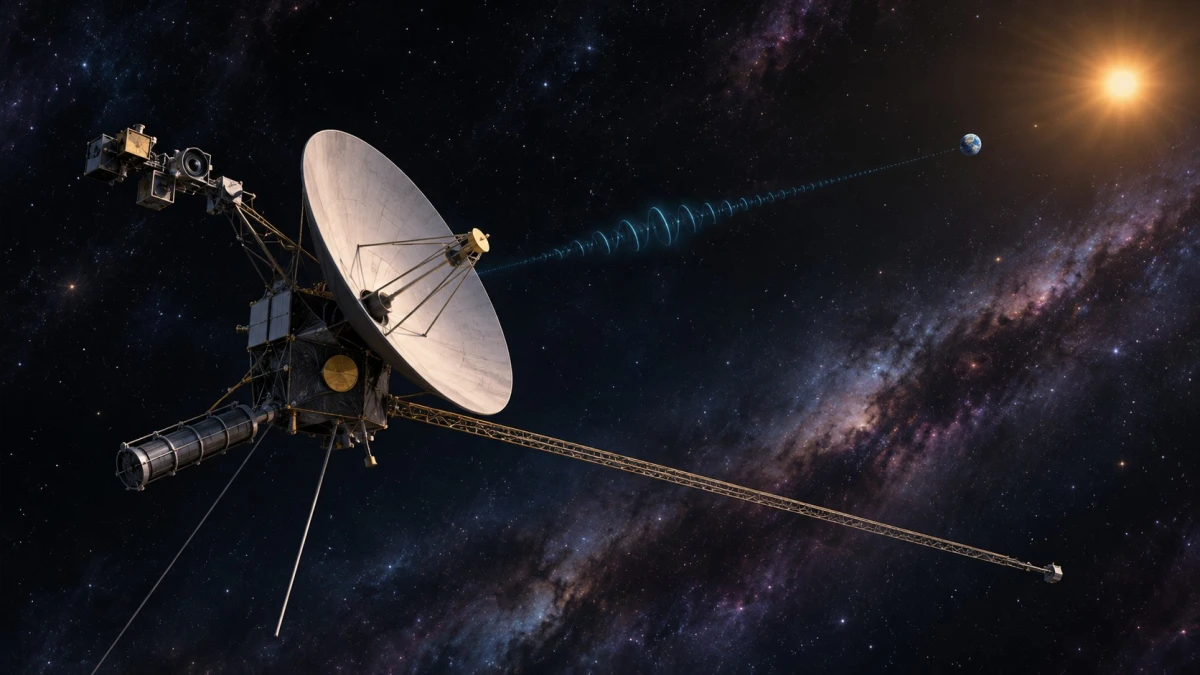
NASA's Voyager 1 spacecraft, launched in 1977, became the first human-made object to reach a distance of one light-day from Earth at 5:16:07 a.m. EST on Wednesday, Nov. 18, 2026, according to NASA's trajectory calculations. At that distance, roughly 16.1 billion miles (25.9 billion kilometers) away, a radio signal traveling at the speed of light needs a full 24 hours to cross between the spacecraft and the ground.
The milestone arrives while engineers are working through a new problem with the probe. NASA said the spacecraft stopped sending science and engineering data on Nov. 14, though its carrier signal is still reaching Earth, and the agency planned to confirm the light-day mark on Thursday, Nov. 19, using that signal and its trajectory models.
What a Light-Day Means
A light-day is a measure of distance, not time. NASA defines it as the distance light travels in 24 hours: 16,094,799,096 miles, or 25,902,068,356 kilometers. Light moves at about 186,000 miles per second, while Voyager 1 is cruising at nearly 38,000 mph (61,000 kph), which is why the probe needed close to half a century to cover the distance.
By NASA's count, Voyager 1 took 49 years, two months and 11 days to travel one light-day beyond Earth. Scientific American, which reported that the spacecraft launched on Sept. 5, 1977, noted that the moon sits about 238,855 miles from Earth, meaning a light-day equals about 67,383 Earth-moon distances placed end to end. The Associated Press reported that, at its current speed, the spacecraft would need roughly another 18,000 years to reach a full light-year.
"Reaching one light-day is an astounding feat, one that I never expected to see," Voyager project manager Suzanne Dodd said, according to Reuters.
A Data Problem Days Before the Milestone
In a mission update published Wednesday evening, NASA said the Voyager 1 team became aware of the issue on Nov. 14, when a Deep Space Network antenna in Canberra, Australia, locked on to the spacecraft and received a carrier signal but no data. A carrier signal is the radio transmission that normally carries the spacecraft's science and engineering information to ground antennas.
According to NASA, the presence of that signal shows that Voyager 1's Attitude and Articulation Control computer is still keeping the spacecraft pointed at Earth and that its antenna and broadcast equipment still work. The missing data suggests the fault lies with the onboard computer that collects information from the probe's subsystems, including its science instruments, and formats it for transmission.
NASA said diagnosing the cause may take weeks or longer because every command takes 24 hours to reach the probe and every reply takes another 24 hours to return. The agency noted that Voyager 1 experienced a similar situation in 2023, when ground controllers received a carrier signal but no data because of a problem with one of the onboard computers, and said that experience is informing the team's approach now.
Engineers are also examining whether the current problem is connected to a communications gap in October, when the mission lost all contact with Voyager 1 for about 48 hours. NASA said the spacecraft resumed communication on its own and operated normally until Nov. 14.
NASA stressed that the engineering issue has no bearing on when the probe crossed the light-day mark. The spacecraft travels away from Earth at a consistent speed on a known trajectory and has no way to change its speed, and mission engineers rely on trajectory models built from years of measurements to know its distance.
Nearly Five Decades in Flight
Voyager 1 and its twin, Voyager 2, launched in 1977 and are managed by NASA's Jet Propulsion Laboratory (JPL), a division of Caltech. NASA credits the pair with historic discoveries at Jupiter and Saturn, and Voyager 2 remains the only spacecraft to have visited Uranus and Neptune. Each probe carries a golden record containing sounds and images from Earth.
Voyager 1 crossed the heliopause, the outer edge of the protective bubble of particles and magnetic fields produced by the sun, to enter interstellar space in 2012, Reuters reported. Voyager 2 followed in 2018. Because Voyager 2 took a different path to reach Uranus and Neptune, NASA projects it will not reach one light-day from Earth until November 2035.
Only two of Voyager 1's 10 instruments remain switched on as part of power-saving measures, Scientific American reported. A JPL representative told Reuters that recent power-saving steps could keep both spacecraft in communication with Earth for three to four more years, adding that there is enough power to keep the current instruments running through the mission's 50th launch anniversary next year.
"Voyager is sending back continuous measurements of magnetic fields, cosmic rays and of plasma waves that we receive on Earth whenever the Deep Space Network points its antenna at Voyager," Dodd said, according to Reuters. She added that the team is still observing effects from the sun, including coronal mass ejections that send shocks as far as Voyager 1.
NASA said Voyager 1 is heading in the direction of the star AC +79 3888, also known as Gliese 445, in the constellation Ursa Minor, and is expected to pass within about 1.7 light-years of it in 40,000 years. The agency said the mission expects to eventually lose both spacecraft to unresolvable engineering issues but plans to keep them operating for as long as possible.
Celebrations and Next Steps
NASA marked the milestone with a public "Shine Bright for Voyager's Light-Day" campaign on Tuesday, Nov. 17, inviting people to flash Voyager's call sign, "VGR," in Morse code after sunset. JPL scheduled a moderated discussion with mission members and NASA leadership for noon EST on Thursday, Nov. 19, in its von Karman Auditorium, including a preview of a NASA+ Voyager documentary planned for release in 2027 for the mission's 50th anniversary.
Sources
- NASA Science: Voyager 1 Engineers Analyze Data Issue, Ready to Confirm Light-day
- NASA Science: Voyager 1: What Is a Light-Day
- NASA Science: Voyager One Light-Day Downloads
- NASA: NASA Invites Media, Public to Join Voyager 1 One-Light Day Activities
- NBC News (Reuters): A milestone for NASA's Voyager 1 probe
- AP: NASA's Voyager 1 closes in on a light-day in interstellar space
- Scientific American: Voyager 1 approaches a 'light-day' milestone
What's Your Reaction?
 Like
0
 Dislike
0
 Love
0
 Funny
0
 Wow
0
 Sad
0
 Angry
0

"iShook Opinion" by Beni E Rachmanov, CEO & Founder of iShook. Explore captivating perspectives on entertainment, lifestyle, and sports at ishookdaily.com. Your go-to for engaging insights.















Comments (0)