Pezeshkian Hits Back at Trump’s ‘Annihilate’ Threat, Offers Diplomacy Without Force
Pezeshkian tells UN Iran will not bend the knee to Trump’s annihilate threat but remains ready for talks without force, per Guardian and Euronews.
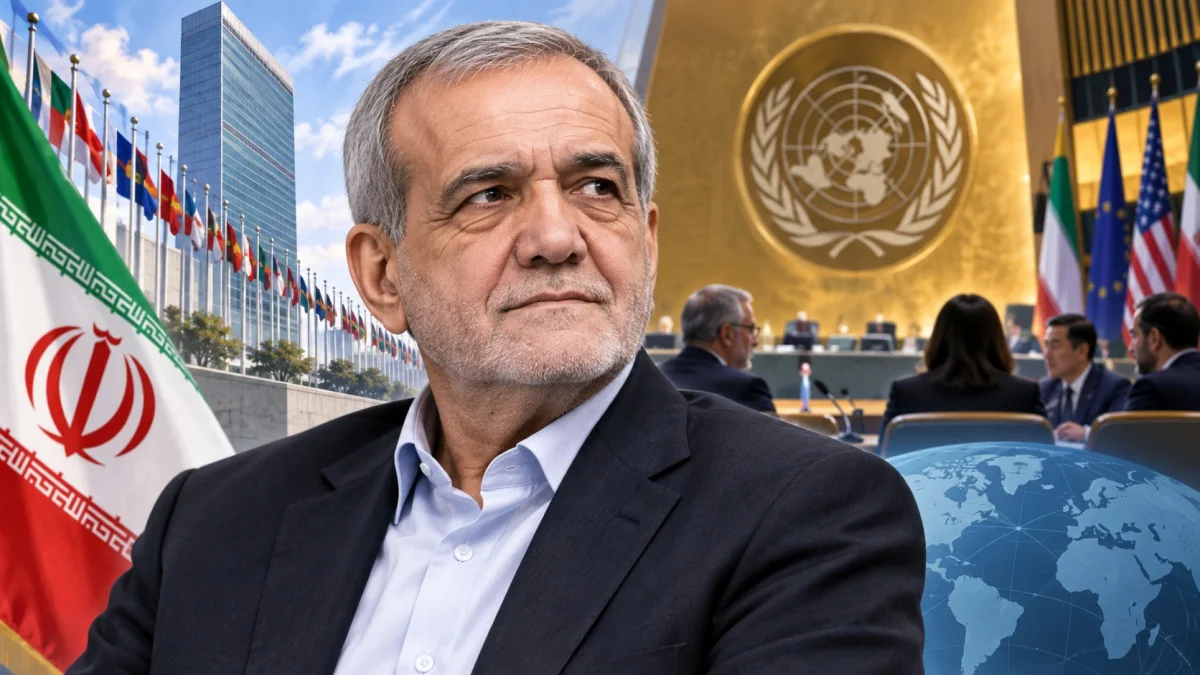
Iranian President Masoud Pezeshkian used his first United Nations General Assembly address since the US–Israel war on Iran to reject Donald Trump’s “annihilate” threat while insisting Tehran remains open to talks — on the condition that force is not the negotiating language, according to The Guardian. Speaking in New York on Wednesday, Pezeshkian cast the United States as the region’s true bully and said Iran’s people had been “victims of terrorism,” flipping Trump’s rhetoric a day after the US president asked the same hall whether Washington would strike a deal or “annihilate the Islamic Republic.”
Pezeshkian balanced defiance with diplomacy. “It must be understood by President Trump and those who seek to bully us that we are ready for dialogue and diplomacy and negotiations but without the language of force,” he said, per The Guardian. He repeatedly vowed Iran would never “bend the knee,” held up photographs of late Supreme Leader Ali Khamenei and schoolchildren killed in the war’s opening days, and insisted Tehran had only defended itself. “We have only defended ourselves. We are not terrorists,” he told the Assembly, arguing Iran’s civilian nuclear programme has no military solution and that regional security should be built among neighbours rather than imposed by outside powers.
Euronews reported that the US delegation walked out as Pezeshkian spoke — a rare wartime address by a foreign leader whose country is formally at war with the host nation. Euronews quoted him accusing Washington and Israel of illegal attacks on civilians and infrastructure, citing the Shajarat al-Tayyiba school strike in Minab that killed 156 people on day one of the conflict, and closing with the line, “Yes they did hit us, but we did not bend the knee.” He also argued “nuclear knowledge should [not] be the exclusive preserve of a few countries,” and said of Hormuz navigation that Iran would not allow its rights “even in our own waters” to be taken away.
The speech landed less than 24 hours after a surprise three-hour meeting between Iranian Foreign Minister Abbas Araghchi and US special envoy Steve Witkoff on the UN sidelines — the first such contact since June, The Guardian noted. Both sides described the exchange as constructive in public, yet Iranian hardliners refused to brand it formal negotiations. Mohsen Rezaei, secretary of Iran’s supreme national security council, said Hormuz would not reopen and talks would not proceed until Tehran’s conditions were met, The Guardian reported. Foreign ministry spokesman Esmail Baghaei stressed Qatari mediation and listed Iranian demands including an end to the naval siege, release of frozen assets, and a halt to “economic war,” while downplaying any shift in position.
Hormuz remains the economic clock. Iran has said the strait could reopen within seven days if its preconditions are satisfied; tanker traffic has fallen to fewer than five identifiable ships a day in recent published counts, The Guardian reported, feeding global fuel-price pressure ahead of US midterms. Pezeshkian used the podium to court Arab neighbours around Hormuz proposals and to warn that arms shipments through the waterway could not be tolerated if those weapons might later be used against Iran — a signal that any reopening deal may involve heavier Iranian oversight of commercial lanes.
US Secretary of State Marco Rubio rejected the victim framing after the speech, telling reporters Iran had no standing to lecture on human rights while “habitually” violating the international system, Euronews reported. Trump, for his part, had already told reporters the Witkoff–Araghchi sit-down was “a very good meeting” even if the Iranian side was “not the highest level.” For markets and allies watching UN week, Wednesday’s message is deliberate ambiguity: Pezeshkian will not accept force as the opening bid, Washington walked out of the chamber, side-channel talks continue, and winter energy prices still hinge on whether Hormuz moves from blockade brinkmanship back toward a managed corridor.
What's Your Reaction?
 Like
0
Like
0
 Dislike
0
Dislike
0
 Love
0
Love
0
 Funny
0
Funny
0
 Wow
0
Wow
0
 Sad
0
Sad
0
 Angry
0
Angry
0
"iShook Opinion" by Beni E Rachmanov, CEO & Founder of iShook. Explore captivating perspectives on entertainment, lifestyle, and sports at ishookdaily.com. Your go-to for engaging insights.












Comments (0)