
Bomb Threats Divert at Least 15 Flights Across Europe in Second Wave This Week
Bomb threats forced diversions and emergency landings for at least 15 passenger flights across Europe on Thursday, the second wave of disruptions this week. Airlines and officials said searches found no explosives, and the UK transport secretary called the incidents malicious hoaxes.
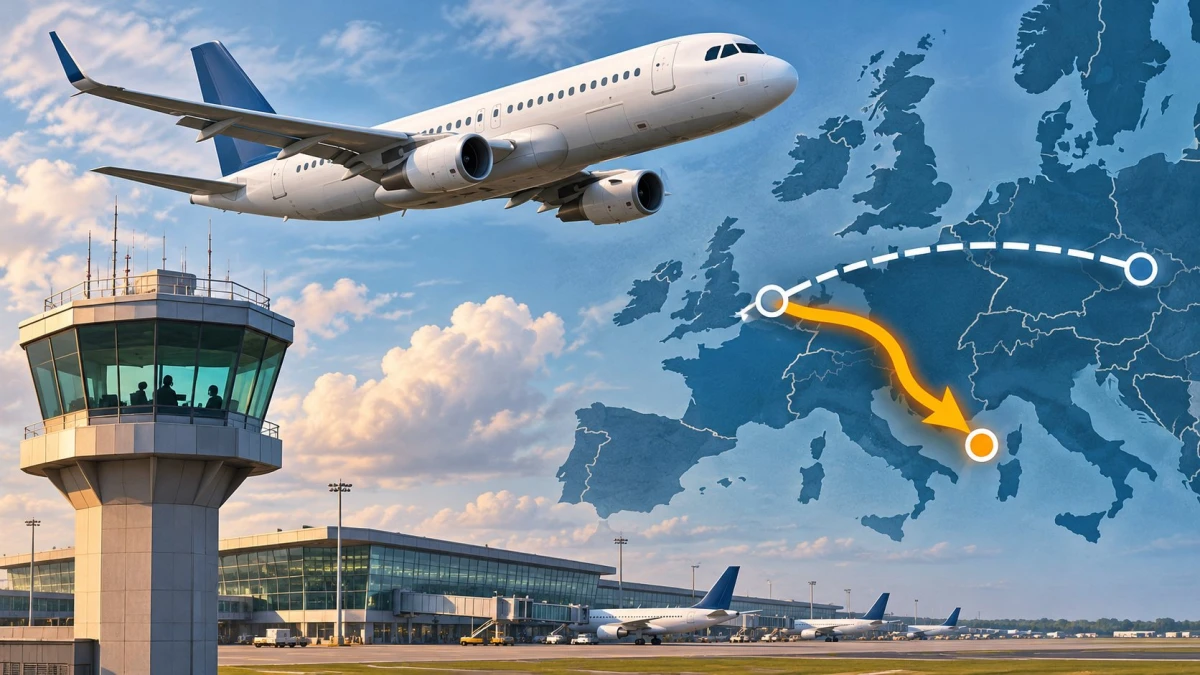
Bomb threats forced diversions, fighter-jet escorts and emergency landings for at least 15 passenger flights across Europe on Thursday morning, Nov. 5, according to The Guardian and BBC News. It was the second wave of disruption this week. Airlines and authorities said aircraft landed safely and that initial searches found no explosives or suspicious items.
The alerts affected routes involving Italy, Ireland, the United Kingdom, Spain, Bulgaria, Romania, Poland, Finland, Austria, Denmark, Belgium, Portugal, Greece and Czechia, The Guardian reported. Carriers named in the reports included Ryanair, Aer Lingus, Wizz Air, Finnair, LOT Polish Airlines and Aegean Airlines. A Guardian live blog later listed about 18 flights in a running tally as more reports came in through the morning.
Diversions, escorts and empty searches
Aer Lingus flight EI402 from Dublin to Rome diverted to the Évreux-Fauville military airbase in northern France as a security precaution, the airline said in statements cited by BBC News. The French prime minister's office said the plane landed safely and that its 151 passengers and six crew members were brought to safety while bomb-disposal teams inspected the aircraft, according to a BBC live blog.
Three Ryanair flights bound for Bulgaria were affected, Bulgarian officials and media reported. Flights from Copenhagen and Madrid landed in Sofia, while a flight from London Stansted destined for Sofia diverted to Plovdiv. Bulgaria's air force said MiG-29 jets took off from Graf Ignatievo Air Base to intercept and escort the civilian aircraft, the BBC reported. A Bulgarian government spokesperson told The Guardian that inspections found no issues and that operations at Sofia and Plovdiv airports had returned to normal.
Italian Air Force fighter jets escorted a Finnair flight from Helsinki into Rome's Fiumicino Airport, where it landed as scheduled, Aeroporti di Roma told the BBC. Another Finnair flight from Helsinki to Vienna also received a threat and landed normally; Finnair described both alerts as "unfounded or hoax." A Wizz Air flight from Milan to Warsaw diverted to Vienna under security protocols, and a Wizz Air flight from Milan to Bucharest was inspected after landing. LOT said a Warsaw-to-Brussels flight landed as planned with "no suspicious items" found, and that a Warsaw-to-Paris flight was stopped while taxiing so the aircraft and baggage could be screened.
Czech police said four airplanes heading to Prague received bomb threats; pyrotechnic inspections yielded negative results, a police spokesperson said, according to The Guardian and BBC News. An Aegean Airlines flight from Thessaloniki and a Ryanair flight from Porto, both bound for Milan, were searched on arrival at Milan Malpensa, Italy's Ansa news agency reported.
Earlier alerts this week
Thursday's incidents followed a string of alerts earlier in the week. BBC News reported that at least seven or eight European flights were targeted on Tuesday, including two from the United Kingdom, and that no explosives were found after searches. The Guardian said seven planes were searched or diverted two days earlier over malicious hoax bomb alerts, and that a flight from the United Kingdom to Bulgaria was diverted on Monday after a threat that appeared without substance.
Philip Baum, a professor of aviation security at the University of Coventry, told the BBC that the industry faces multiple bomb threats every day, but that he had been surprised by this week's pattern. A flight is diverted "only when the threat is credible and the authorities believe there is a potential of explosive device on board," he said. Marco Chan, an aviation expert at Kingston University and a former airline pilot, told the BBC the threats were "most likely a hoax, but the system is right to treat it as real," and that three days of incidents was "too small a sample to separate coordination from contagion."
What officials and analysts say
UK Transport Secretary Heidi Alexander described the incidents as "malicious hoax threats," saying the government takes such threats seriously and that established processes are in place to handle them, according to BBC News. EU Transport Commissioner Apostolos Tzitzikostas said it was "too early" to conclude whether the reported incidents are linked and that "any threats against civilians are unacceptable," The Guardian and BBC reported.
Rome airport authorities told the BBC that a threat email received Thursday came from a group calling itself "Fighters of the Male State," claiming to target a "feminist regime." Separately, Ansa, citing police sources, said the warning for the Helsinki-Rome and Dublin-Rome flights arrived in an anonymous email written in Italian with the subject line "segnalazione minaccia" ("threat warning"), The Guardian reported.
A Reuters world news summary carried by DevDiscourse said none of the Thursday threats immediately proved genuine and that, while no country had attributed blame, the alerts came as European officials have accused Russia and Iran of "hybrid attacks" and sabotage — claims Moscow and Tehran deny. The Guardian reported that some analysts have speculated the flight disruptions, along with other recent incidents, could fit a hybrid campaign; Kremlin spokesperson Dmitry Peskov on Thursday called it "absurd" to blame Russia's administration for related cyber accusations involving hackers who targeted fridges.
Former airline pilot Capt. Martin Drake, a technical adviser to the Balpa union, told The Guardian that airline security teams rate threats on a traffic-light scale and that once a flight is airborne, a "red" assessment typically means descending and diverting. Aviation experts quoted by The Guardian said fake threats occur daily, but that a multiplicity of alerts judged credible enough to force airborne responses points toward coordinated action — even if the threats themselves are hoaxes.
No injuries related to the threats were reported. Airlines said they were working to rebook passengers whose flights were diverted or delayed.
Sources
- The Guardian: Bomb threats disrupt flights across Europe and renew hybrid warfare fears
- The Guardian live: Multiple planes diverted as bomb threats reported across Europe
- BBC News: Multiple European flights targeted by bomb threats for second time this week
- BBC News live: Plane bomb threats across Europe
- DevDiscourse / Reuters: World news summary — new wave of bomb threats hits passenger flights across Europe
What's Your Reaction?
 Like
0
 Dislike
0
 Love
0
 Funny
0
 Wow
0
 Sad
0
 Angry
0

"iShook Opinion" by Beni E Rachmanov, CEO & Founder of iShook. Explore captivating perspectives on entertainment, lifestyle, and sports at ishookdaily.com. Your go-to for engaging insights.













Comments (0)