Iran Offers to Reopen Hormuz in Seven Days if U.S. Eases Pressure
Iran offers to reopen Hormuz within seven days if the U.S. eases pressure and lifts its port blockade, while Rubio says UN talks remain open, per Reuters.
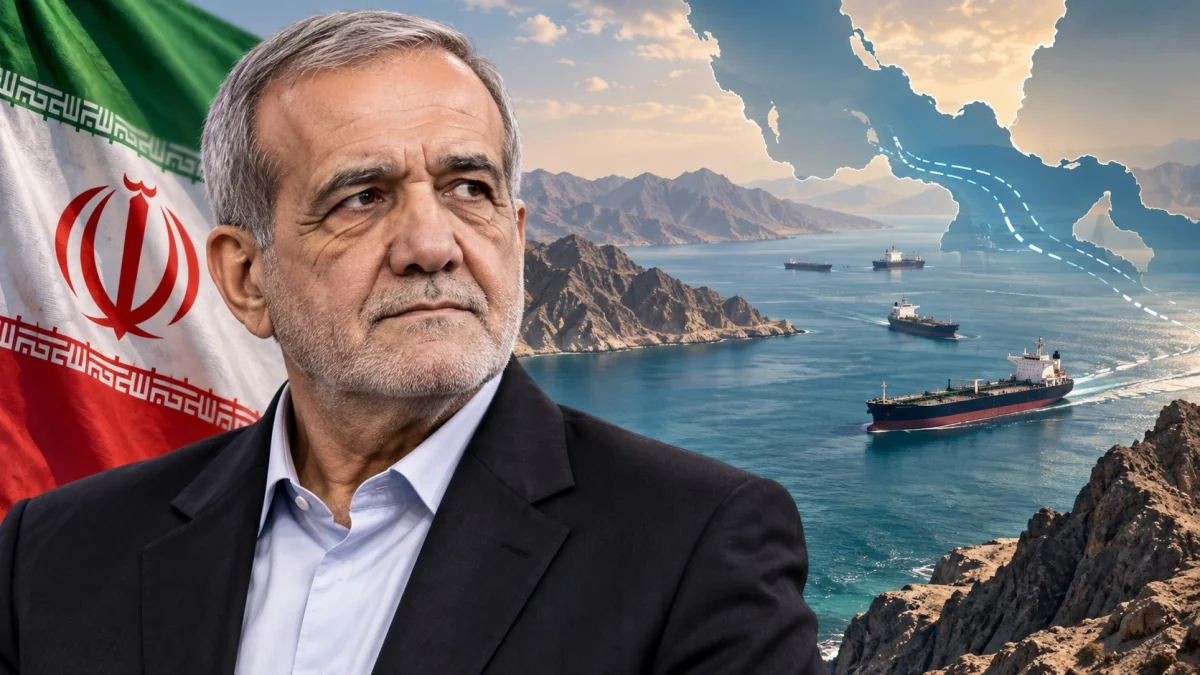
Iran says it can reopen the Strait of Hormuz within seven days if the United States eases military pressure and lifts its blockade on Iranian ports, a senior Iranian official told Reuters on Tuesday as world leaders gathered in New York for the United Nations General Assembly. The conditional offer lands amid weeks of shipping disruption through one of the planet’s most critical energy chokepoints and a broader Middle East conflict that has also unsettled the Red Sea corridor.
The same official said Tehran’s UN delegation is already in New York with full authority to revive diplomacy with Washington, and that a concrete proposal to end hostilities was delivered to the United States through mediators on September 16. “The US needs to announce that it wants to resolve the issue diplomatically, make that official, and then agree on a timeline for how the process will move forward,” the official told Reuters, calling the General Assembly a “golden opportunity” for Washington to return to talks. Iranian President Masoud Pezeshkian left Tehran for New York on Tuesday but will not meet President Donald Trump at UN headquarters, according to the same account.
Secretary of State Marco Rubio, speaking separately to NBC’s Today show, said the United States is open to speaking with Iranians at the General Assembly even though no meeting is currently scheduled. “We’re open to that. I dont think anything is scheduled at this point, but we’re certainly open to something like that, especially if it has the prospects of leading to something positive,” Rubio said, repeating that Iran “can never have a nuclear weapon.” The parallel messages—conditional reopening from Tehran and cautious openness from Washington—outline the narrow diplomatic lane both sides still claim to want while military threats remain loud.
On Sunday, Iran’s military central command said it had been informed the United States was preparing to restart military operations with regional support and warned that any such move would trigger Iranian retaliation “without limitations and considerations.” That warning sits beside months of contested shipping through Hormuz, where vessels have trickled rather than flowed as insurers, traders, and energy markets price in risk. Roughly a fifth of global oil trade typically moves through the strait in calmer periods; even partial closures ripple into diesel, jet fuel, and industrial feedstock costs far from the Gulf.
Pressure on maritime security is not limited to Hormuz. In a Tuesday phone call reported by Reuters, Russian President Vladimir Putin and Saudi Crown Prince Mohammed bin Salman emphasized the need for safe, unimpeded passage through both the Strait of Hormuz and the Bab el-Mandeb, while urging a political settlement in Yemen. Saudi Arabia has already had to lean more heavily on alternative export routes, including Egypt’s Suez Canal, after disruption on its usual Gulf and Red Sea pathways. The Kremlin readout stressed that diplomacy remains the only viable path forward—language that tracks Tehran’s public insistence on mediated talks in New York.
For entertainment and news audiences watching geopolitics primarily through its cultural and market spillover, the Hormuz story matters because it is simultaneously a security standoff and a logistics story. Cruise itineraries, film location insurance, touring schedules, and advertising budgets all feel oil-price volatility when shipping lanes tighten. Tuesday’s reporting does not resolve the conflict, but it does clarify what each capital says it needs: Iran wants tangible U.S. de-escalation and an end to port blockade pressure; Washington wants diplomatic contact that advances its nonproliferation red line; Gulf partners want traffic restored through international waterways before markets harden into a long disruption.
Whether mediators can convert those overlapping talking points into a sequenced deal remains the open question of UN week. Pezeshkian’s presence in New York without a Trump bilat suggests any progress would likely travel through intermediaries rather than a leader-to-leader handshake. Rubio’s carefully hedged openness keeps a door ajar without promising a calendar. And Irans seven-day reopening claim, if verified through shipping data, would give markets a measurable test of whether words on the East River translate into freer movement through the Gulf. For now, the verified picture is simpler: Tehran tabled a conditional Hormuz offer on Tuesday, Washington said it is open to UN contact, and major energy exporters continue to press for safe passage while hostilities elsewhere in the region keep insurers nervous.
What's Your Reaction?
 Like
0
Like
0
 Dislike
0
Dislike
0
 Love
0
Love
0
 Funny
0
Funny
0
 Wow
0
Wow
0
 Sad
0
Sad
0
 Angry
0
Angry
0
"iShook Opinion" by Beni E Rachmanov, CEO & Founder of iShook. Explore captivating perspectives on entertainment, lifestyle, and sports at ishookdaily.com. Your go-to for engaging insights.











Comments (0)