
Taiwan Local Elections: KMT Holds Taipei as DPP Flips Taichung, Voters Back Nuclear Power
Taiwan's opposition Kuomintang kept the Taipei mayoralty in Nov. 28 local elections, but the ruling Democratic Progressive Party flipped six city and county governments, including Taichung, doubling its total to 10. Voters also approved a referendum calling for an end to the government's "nuclear-free homeland" energy policy.
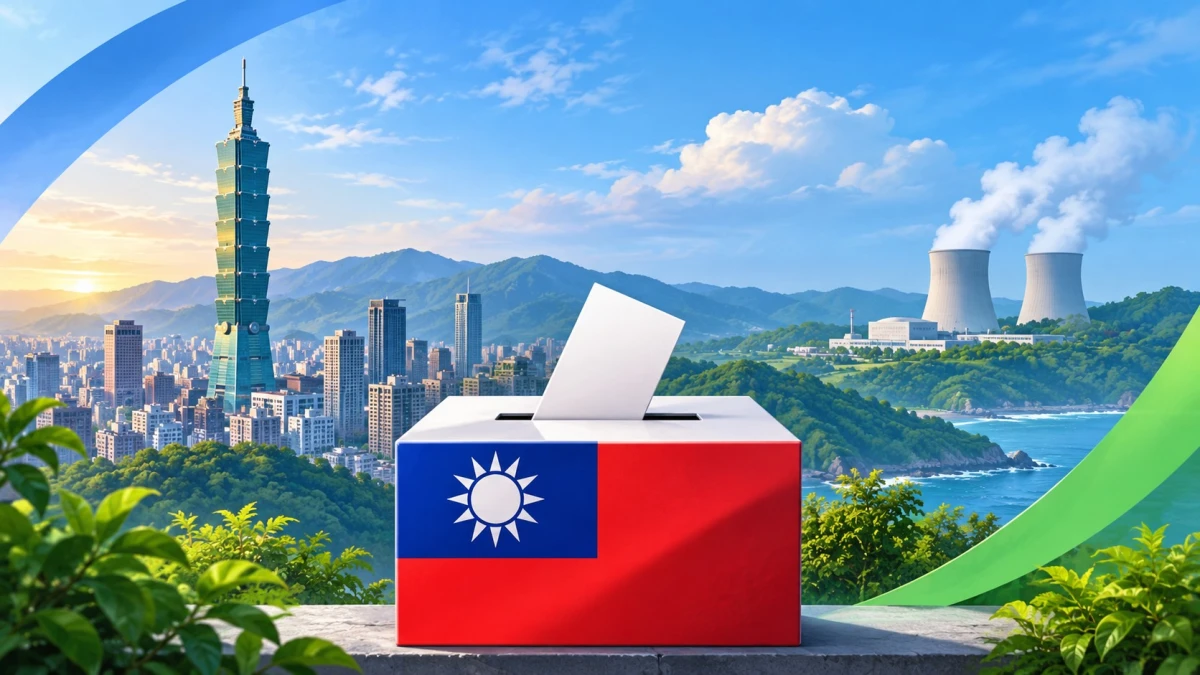
Taiwan's main opposition party, the Kuomintang (KMT), kept control of the capital, Taipei, in local elections on Saturday, Nov. 28, but lost six city and county governments to the ruling Democratic Progressive Party (DPP), including the central city of Taichung, according to results from the Central Election Commission reported by Taiwan's Central News Agency (CNA). Voters also approved a referendum calling for the end of the government's "nuclear-free homeland" energy policy.
Of the 22 mayor and county magistrate posts at stake, the KMT won 11, down from 14 in 2022, while the DPP won 10, double the five it secured four years ago, CNA reported. Independent Kao Hung-an kept the Hsinchu City mayoralty. The results are being watched as a gauge of party strength ahead of presidential elections due in early 2028, BBC News reported.
Chiang Holds Taipei Against Puma Shen
In the most closely watched race, incumbent Taipei Mayor Chiang Wan-an of the KMT won a second four-year term with nearly 54% of the vote, defeating the DPP's Puma Shen, a legislator and former civil defense activist who has been sanctioned by Beijing, according to the BBC. Singapore's Lianhe Zaobao reported that Chiang's margin was 116,726 votes, a lead of 8.03 percentage points. Four years ago, Chiang won with more than 67% of the vote, the BBC noted.
The BBC reported that Beijing had described Shen as a "danger to stability" in the Taiwan Strait during the campaign, and that BBC Verify found the DPP was repeatedly targeted with videos generated by artificial intelligence spreading false claims about Shen and President Lai Ching-te. The DPP has not held the Taipei mayor's office for nearly three decades, according to the BBC.
Conceding defeat on Saturday evening, Shen told supporters, "Taiwan's democracy is worthy of trust. We can lose an election, but we cannot lose Taiwan's democracy," according to Lianhe Zaobao. In his own remarks, Chiang said a "silent majority" in Taipei wanted "stability, prosperity and practical solutions to problems, rather than political noise and division," the BBC reported.
DPP Gains in Central Taiwan
The DPP's largest gain came in Taichung, where DPP candidate Ho Hsin-chun won 50.68% of the vote to defeat KMT candidate Johnny Chiang, ending eight years of KMT rule under outgoing Mayor Lu Shiow-yen, Lianhe Zaobao reported. The DPP also took Hsinchu County, Changhua County, Yunlin County, Chiayi City and Yilan County from the KMT, and held its southern strongholds of Tainan and Kaohsiung, according to CNA.
The KMT held the northern municipalities of Taipei, New Taipei and Taoyuan, and took the offshore county of Penghu from the DPP, CNA reported. Taiwan's six special municipalities are now split evenly, three for each party, compared with four for the KMT and two for the DPP after the 2022 elections, according to Lianhe Zaobao.
In council races nationwide, the KMT remained the largest party with 344 seats, a loss of 23 from 2022, while the DPP gained 31 seats for a total of 309, according to CNA, citing Central Election Commission figures. In all, 11,051 local offices were contested in what are known as the "nine-in-one" elections.
Two county races remain in dispute. In Yunlin County, the DPP's Liu Chien-kuo finished 173 votes ahead of the KMT's Chang Chia-chun, and in Hualien County, the KMT's Yu Shu-chen led independent candidate Chang Chun by 357 votes, CNA reported. Both trailing candidates said Sunday they were seeking recounts.
Leaders Respond
President Lai, who also chairs the DPP, said at party headquarters Saturday night that "the election results reflect the true feelings of the people," CNA reported. KMT Chairwoman Cheng Li-wun called the outcome a setback from 2022 and promised a review. "Whether we won or lost, we will conduct the most comprehensive and thorough review in every city, county, and constituency across Taiwan," Cheng said, according to CNA.
Qi Dongtao, a senior research fellow at the National University of Singapore's East Asian Institute, told Lianhe Zaobao the vote amounted to a "small loss" for the KMT and a "small win" for the DPP. Lev Nachman, an associate professor at National Taiwan University, told the BBC that the DPP's failure to win Taipei does "take the wind out of [Lai Ching-te's] re-election sails."
"No matter how Taiwan's political landscape changes, it cannot alter the forward trajectory of cross-strait relations, much less halt the overarching historical trend that the motherland must and will inevitably be reunified," Zhang Han, a spokesperson for China's Taiwan Affairs Office, said Sunday, according to CNA, citing Xinhua. Taiwan's Mainland Affairs Council responded that "the Beijing authorities should respect Taiwan's democratic system and the choices of the Taiwanese people," CNA reported.
Voters Back Nuclear Power
A national referendum held alongside the elections passed with 7,434,677 votes in favor and 4,557,768 against, the Taipei Times reported, citing the Central Election Commission. The "yes" votes equaled 37.17% of the roughly 20 million eligible voters, above the one-quarter threshold needed for passage, and turnout reached 62.79%. The KMT-initiated question asked whether voters supported using nuclear power to boost the economy and abolishing the "nuclear-free homeland" policy.
Cheng said the outcome showed public support for nuclear power and called on the government to adjust its energy policy to meet the needs of the artificial intelligence industry, CNA reported. Executive Yuan spokesperson Michelle Lee said the Cabinet respected the result but that the government's position on nuclear power was unchanged, and that it would uphold the principles of ensuring nuclear safety, resolving the nuclear waste issue and building a social consensus, according to the Taipei Times. The anti-nuclear National Nuclear Abolition Action Platform called the referendum's wording more of a "push poll," the newspaper reported.
Sources
- Focus Taiwan (CNA): DPP flips Taichung, 5 other seats in local elections; KMT holds onto Taipei
- Focus Taiwan (CNA): Lai hails democratic process; KMT pledges self-review after local elections
- Focus Taiwan (CNA): Taiwan calls on Beijing to respect voters' choices after local elections
- Focus Taiwan (CNA): DPP leads in major cities' council seats, KMT ahead nationwide
- Focus Taiwan (CNA): 3 election candidates to seek recounts after narrow defeats
- BBC News: Taiwan's opposition fends off Beijing critic to hold Taipei mayoralty
- Lianhe Zaobao: KMT holds Taipei and New Taipei but loses Taichung as Blue and Green camps split six major cities
- Lianhe Zaobao: KMT wins 11 counties and cities in Taiwan's nine-in-one elections; DPP increases tally to 10
- Taipei Times: Nuclear energy referendum passes with 7 million 'yes' votes
- Radio Taiwan International: 2026 Taiwan Local Elections campaign news
What's Your Reaction?
 Like
0
 Dislike
0
 Love
0
 Funny
0
 Wow
0
 Sad
0
 Angry
0

"iShook Opinion" by Beni E Rachmanov, CEO & Founder of iShook. Explore captivating perspectives on entertainment, lifestyle, and sports at ishookdaily.com. Your go-to for engaging insights.














Comments (0)