
Russia Votes as Ukraine Hits Moscow With 350-Plus Drone Barrage
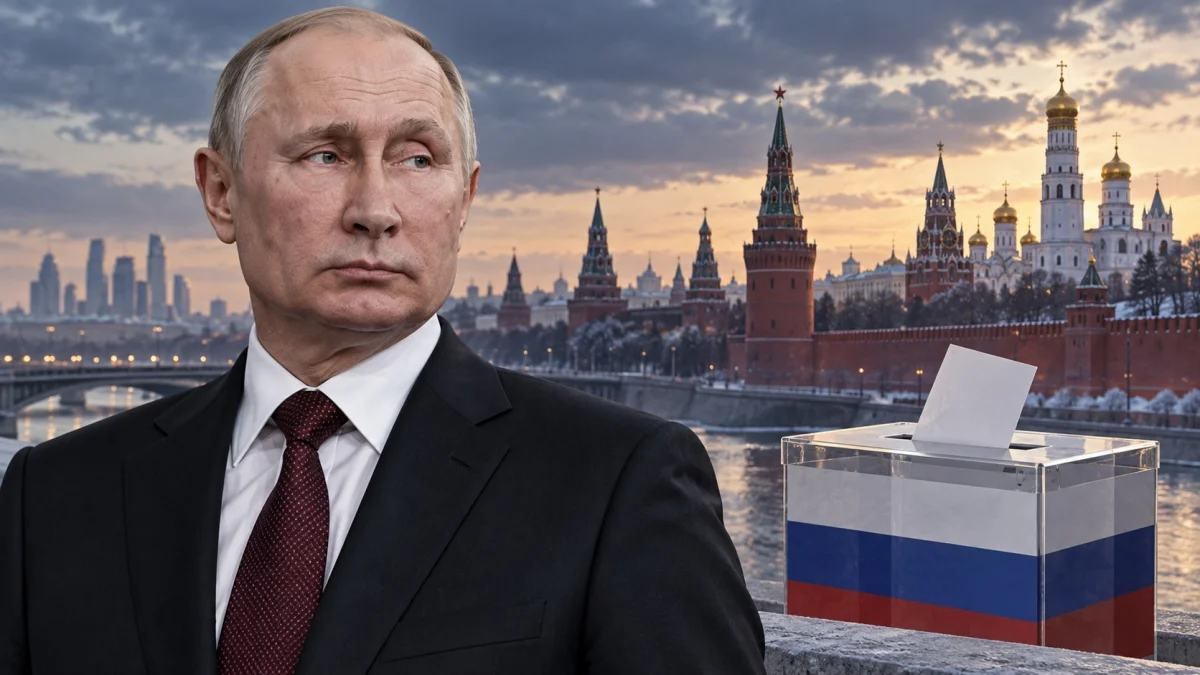
Russians began casting ballots on Friday in a three-day parliamentary election that President Vladimir Putin has framed as a public show of support for the war in Ukraine, even as Kyiv answered the vote’s opening hours with a large overnight drone assault on the Russian capital. Reuters reported that voting got underway across Russia’s 11 time zones for the 450-seat State Duma, the first lower-house contest since Moscow launched its full-scale invasion in February 2022. Polls opened first in the Far East, including Kamchatka and Chukotka on the Pacific, before moving west through the country.
Putin, in a televised address ahead of the ballot, cast the election as a test of national resolve. Casting a vote, he said, would demonstrate that “millions of people stand behind our soldiers” and that the country would not be divided or intimidated. State television ads urging turnout mixed historical military imagery with battlefield scenes and the slogan that a citizen’s ballot is “the strength of Russia.” Initial partial results are expected from about 1800 GMT on Sunday, with near-complete tallies due Monday, according to Reuters.
The political field is tightly controlled. United Russia, the ruling party that has dominated Russian politics for a generation, is widely expected to retain its commanding position. Most anti-war candidates were kept off the ballot. The liberal Yabloko party, which has called for a ceasefire, was barred after a Supreme Court ruling last month that it breached electoral rules—an allegation the party denied. Some Yabloko candidates are still running in individual constituencies that make up half the Duma’s seats, but the broader anti-war slate has been squeezed. Senior Yabloko figures have also faced lengthy prison terms for comments about the war, under laws that criminalize “discrediting” the army or spreading what authorities call fake news.
While the Kremlin treats the vote as a barometer of wartime unity, independent polling cited by Reuters has shown public support for peace talks rising above 60 percent in some surveys. Moscow says it is ready to resume talks, but it continues to insist that any settlement leave Russia in full control of the Donetsk region and that it wants a long-term deal rather than a short ceasefire. Voting is also taking place in Russian-occupied parts of Ukraine, a move Kyiv and much of the West reject as illegitimate.
The election opened under an aerial counterpoint. Al Jazeera, citing Moscow Mayor Sergei Sobyanin, reported that more than 350 Ukrainian drones targeted the capital on Friday morning. Sobyanin said most were destroyed at an outer defensive perimeter, with 64 shot down as they approached the city. Kyiv has for months used deep strikes on energy and logistics sites to make the war feel closer to Russian civilians and industry; Friday’s barrage fit that pattern as ballots opened. Ukrainian President Volodymyr Zelenskyy said Ukrainian forces also hit the Yaroslavl oil refinery overnight and damaged military aircraft and helicopters at a Rostov airfield, claiming “good results” in the Black Sea without providing detail.
Russia answered with its own strikes. The Defence Ministry said it hit a Nova Poshta logistics hub near Odesa and a cargo vessel at Chornomorsk, describing both as military targets. A Russian drone attack in the Kyiv region injured five people, including three children, regional governor Tymur Tkachenko said. The exchange underscored how little the political calendar has cooled the fighting now in its fifth year.
On the ground, ordinary voters voiced a mix of fatalism and doubt. A 76-year-old Muscovite told Reuters he expected outcomes somewhere between grim and optimistic forecasts, accepting that war means higher defence spending and social cuts. Another voter, speaking anonymously, said results could be rigged and questioned electronic voting systems used in some regions—claims the electoral commission rejects. Fuel shortages linked to Ukrainian strikes on refineries, high interest rates, labour shortages, and Western sanctions continue to strain the wartime economy even as the Kremlin demands visible unity.
For international audiences, Friday’s twin storylines—ballots and drones—capture the contradiction at the heart of Russia’s wartime politics. The state is staging a carefully managed show of consent while Ukraine tries to pierce that narrative with visible disruption at home. Whether United Russia’s expected victory is read as genuine enthusiasm or engineered inevitability will matter less to the Kremlin than the image of a nation still marching in step. For now, the three-day vote proceeds under air-raid alerts and tightly drawn ballot lines, with the war’s human and economic costs never far from the polling-station door.
What's Your Reaction?
 Like
0
Like
0
 Dislike
0
Dislike
0
 Love
0
Love
0
 Funny
0
Funny
0
 Wow
0
Wow
0
 Sad
0
Sad
0
 Angry
0
Angry
0

"iShook Opinion" by Beni E Rachmanov, CEO & Founder of iShook. Explore captivating perspectives on entertainment, lifestyle, and sports at ishookdaily.com. Your go-to for engaging insights.












Comments (0)