
Trump Rejects UN AI Regulation, Rebrands Field as ‘Super Intelligence’
Trump rejects international AI regulation at UNGA Tuesday, calling it a globalist scheme and renaming AI “super intelligence,” as the Security Council prepares an AI hearing, per Scientific American and Euronews.
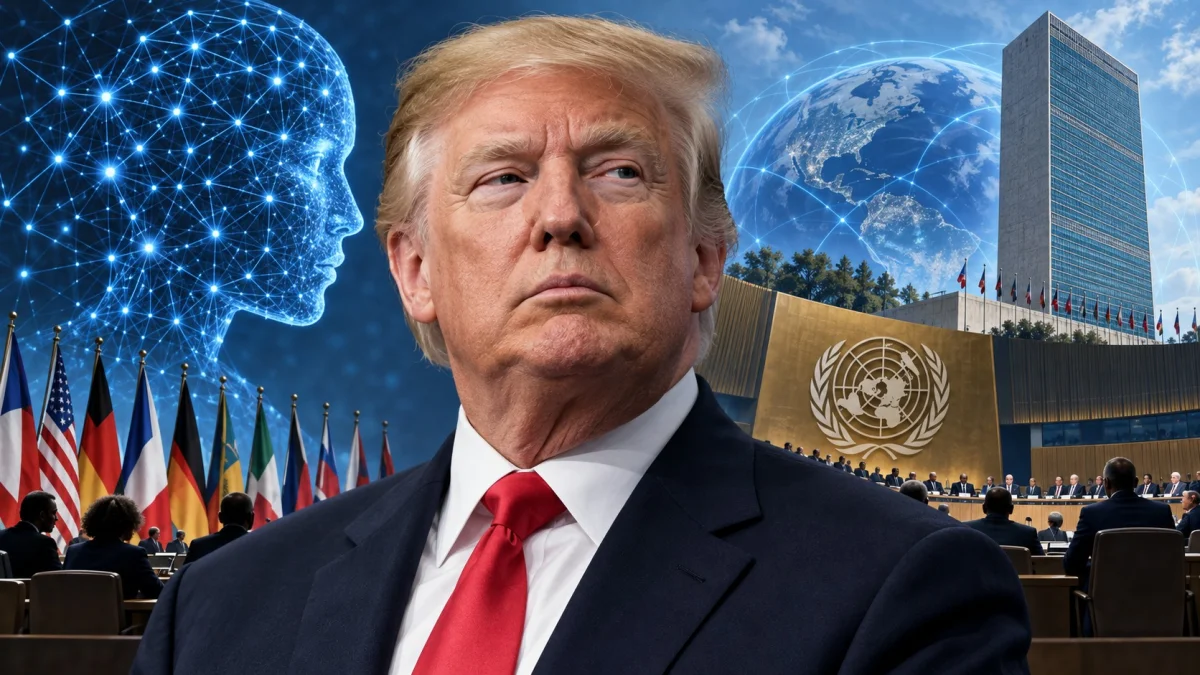
US President Donald Trump used his United Nations General Assembly address on Tuesday to reject international efforts to regulate artificial intelligence, casting multilateral safeguards as a “globalist scheme” and arguing that whoever masters the technology first wins, according to Scientific American. Trump told the Assembly he would not “stifle growth of something that will be bigger than the industrial revolution,” framing US technological leadership as both an economic and geopolitical priority.
In the same speech, Trump said the United States would stop calling the field artificial intelligence” and instead use “super intelligence,” arguing that the word artificial makes the technology sound fake. Scientific American reported that the rebrand followed a social-media poll in which he floated alternatives such as “Superior Intelligence,” “Extreme Intelligence, and “Supreme Intelligence.” On the Assembly floor he insisted the technology is “actually amazing,” while adding only that governments still “have to be careful.”
Euronews, drawing on Associated Press coverage from New York, described a sharp clash of visions inside the same UN week. Minutes before Trump spoke, Secretary-General António Guterres opened the General Debate by urging “responsible pacing” of AI and warning that life-and-death decisions must never be surrendered to machines. Killer robots must have no place in our future,” Guterres said in his farewell address to world leaders, citing a new UN science report that flags a slight but real chance of catastrophic, irreversible harm.
Euronews noted that the UN Security Council was scheduled to take up AI controls on Wednesday, with OpenAI chief executive Sam Altman, Anthropic chief executive Dario Amodei, and Hugging Face co-founder Clément Delangue among the invited speakers. That hearing sits directly opposite Trump’s rejection of a coordinated international regime: industry figures who have publicly called for pacing and guardrails are being asked to explain risks in a chamber that Trump’s address effectively told to stand down.
Other leaders tried to stake out a middle path. French President Emmanuel Macron argued that governments should not wait for harms to come raining down,” especially on children and young people. Finland’s Alexander Stubb called AI “the most consequential technology in the history of mankind and said cooperation, not an unchecked race, was the best way forward. British Prime Minister Andy Burnham told a sideline business meeting he wants “a single set of global principles and standards,” positioning AI for good as a priority for the United Kingdom’s coming G20 presidency, Euronews reported.
University of Chicago computer-science chair Henry Hoffmann told Euronews that both the apocalyptic and dismissive framings are unhelpful. Reducing the debate to science-fiction disaster or to a nonissue, he said, pushes audiences to pick teams instead of examining which control mechanisms actually work on powerful autonomous systems. That critique lands between Guterres’s vivid warning language and Trumps insistence that AI critics are recycling failed climate alarmism.
Scientific American placed Trumps AI remarks in continuity with his climate politics: he compared AI risk talk to warnings that we’ll all be dead in 12 years because of global warming, restated his view that climate change has been oversold, and reiterated opposition to what he calls global governance projects. The magazine also noted the contrast with recent calls for greater regulation from Altman and Amodeifigures now appearing before the Security Council even as Washington rejects a UN-centered control scheme.
For capitals watching the Assembly, the signal is divergence rather than consensus. The White House is prioritizing speed and US lead in what Trump calls the race for super intelligence. The UN system is trying to lock in pacing language, lethal-autonomy red lines, and a Security Council conversation with the builders of frontier models. Whether Wednesdays council session produces anything more than staged testimony—and whether other major powers treat Trump’s rebrand as substance or sloganwill shape how seriously markets and allies take the week’s AI diplomacy.
What's Your Reaction?
 Like
0
Like
0
 Dislike
0
Dislike
0
 Love
0
Love
0
 Funny
0
Funny
0
 Wow
0
Wow
0
 Sad
0
Sad
0
 Angry
0
Angry
0
"iShook Opinion" by Beni E Rachmanov, CEO & Founder of iShook. Explore captivating perspectives on entertainment, lifestyle, and sports at ishookdaily.com. Your go-to for engaging insights.













Comments (0)