
NATO Jets Down Drone Over Lithuania as Russia Fires Flares at Danish Helicopter
NATO jets down a drone over Lithuania as Russia fires flares near a Danish helicopter, escalating Baltic tensions, per the Guardian and BBC.
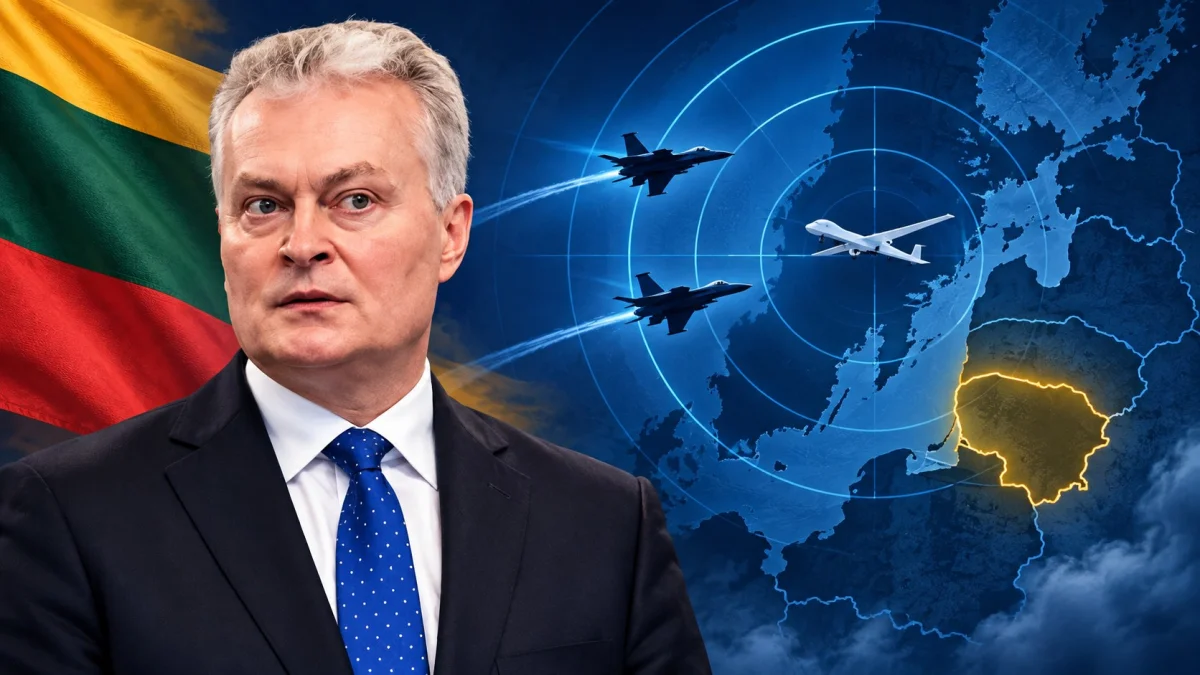
NATOs eastern flank absorbed another day of overlapping incidents on Tuesday as alliance fighter jets destroyed a drone that entered Lithuanian airspace and Denmark condemned a Russian warship for firing emergency flares toward one of its helicopters in the Baltic Sea, according to The Guardian. Polish forces also scrambled jets as a precaution while Russian unmanned aircraft struck targets inside Ukraine, the paper reported, less than a day after Warsaw recovered a suspected Russian drone from Baltic waters.
Lithuanian President Gitanas Nausėda said early Tuesday that a drone that had just entered Lithuanian airspace was destroyed by NATO fighter jets, framing the shoot-down as readiness made necessary by Russia’s intensifying war against Ukraine. Citing preliminary data from Lithuania’s national crisis management centre, LRT public radio reported that the aircraft came from neighbouring Belarus, was heading west, and was shot down by an Italian fighter jet on a NATO mission near Lake Kaunas. Defence officials said the wreckage fell in a rural area near Pratkunai village outside Kaunas; one account placed the intercept near a pumped-storage hydroelectric plant. A presidential security adviser said the drone may have strayed off course, while Lithuania’s state defence council was scheduled to meet Wednesday to review air defences, The Guardian reported.
Denmark’s parallel protest concerned the Baltic approaches. The Danish armed forces said late Monday that an air force Fennec helicopter photographing a Russian frigate in international waters off southern Denmark was fired on with flares, and that one flare passed at close range. Prime Minister Mette Frederiksen called the episode “reckless action from Russia towards Denmark,” arguing that Moscow’s behaviour is meant to intimidate and divide. Foreign Minister Lars Løkke Rasmussen said the Russian ambassador had been summoned and warned that Russia is gradually shifting the boundary of what it considers acceptable behaviour in the Danish straits—critical commercial and military waterways that also serve as an artery for oil shipments, including vessels linked to Russia’s so-called shadow fleet.
Poland’s activity underlined how quickly alerts now cascade along NATOs border with Ukraine. Warsaw said early Tuesday it had launched aviation operations because Russian jet-powered drones were striking Ukrainian territory; the flights were later described as preventive and concluded without a Polish airspace violation. On Monday, Defence Minister Władysław Kosiniak-Kamysz said the military had recovered a drone from the Baltic near Rusinowo that preliminary inspection indicated was a Russian Gerbera—a cheap long-range type often used as a decoy but also capable of carrying explosives.
The Baltic and Lithuanian incidents arrived against a separate weekend escalation closer to the EU’s doorstep. The BBC reported that a Russian drone struck a train near Yahodyn on the Ukraine-Poland border shortly after former UK prime minister Boris Johnson and European national security advisers—including Britain’s Jonathan Powell—had passed through on another train returning from Kyiv’s Yalta European Strategy conference. No casualties were reported after passengers were evacuated; Ukraine’s railway company said an evacuation order went out about 15 minutes before the strike and that the diplomatic train had left earlier than scheduled because of constant strike threats. Ukrainian and Polish authorities said the hit occurred roughly two kilometres from the Polish border. Ukrainian Foreign Minister Andrii Sybiha called the Yahodyn strikes Putin’s terror “knocking” on the doors of the EU and NATO, while Polish Prime Minister Donald Tusk convened emergency talks and said Russian actions were getting closer to Poland’s border, the BBC reported.
Together, the Lithuania shoot-down, the Danish flare incident, Poland’s scramble, and the Yahodyn rail strike form a single operational picture for alliance capitals: drones and naval intimidation are no longer confined to Ukraine’s interior. European officials have also accused Russia of diverting Ukrainian drones meant for industrial targets near St. Petersburg, and Baltic states have reported repeated airspace incursions since 2022. For readers tracking how conflict spillover reshapes daily security reporting, the week’s Baltic sequence is less a one-off spectacle than a pattern of probing, recovery, and rapid allied response—exactly the kind of hard-news thread iShook Daily’s Daily News desk is built to follow without speculation.
What remains unresolved is intent versus error on individual aircraft. Lithuanian advisers floated a possible course deviation even as Nausėda stressed readiness; Denmarks account of flares at close range leaves little ambiguity about risk to aircrew. Either way, the diplomatic and military responses—summonses, council meetings, preventive scrambles—show NATO governments treating the eastern flank as an active crisis theatre rather than a distant war zone.
Related: Saudi Arabia response as Houthi strikes raise Hormuz risks; More Daily News.
What's Your Reaction?
 Like
0
Like
0
 Dislike
0
Dislike
0
 Love
0
Love
0
 Funny
0
Funny
0
 Wow
0
Wow
0
 Sad
0
Sad
0
 Angry
0
Angry
0

"iShook Opinion" by Beni E Rachmanov, CEO & Founder of iShook. Explore captivating perspectives on entertainment, lifestyle, and sports at ishookdaily.com. Your go-to for engaging insights.















Comments (0)